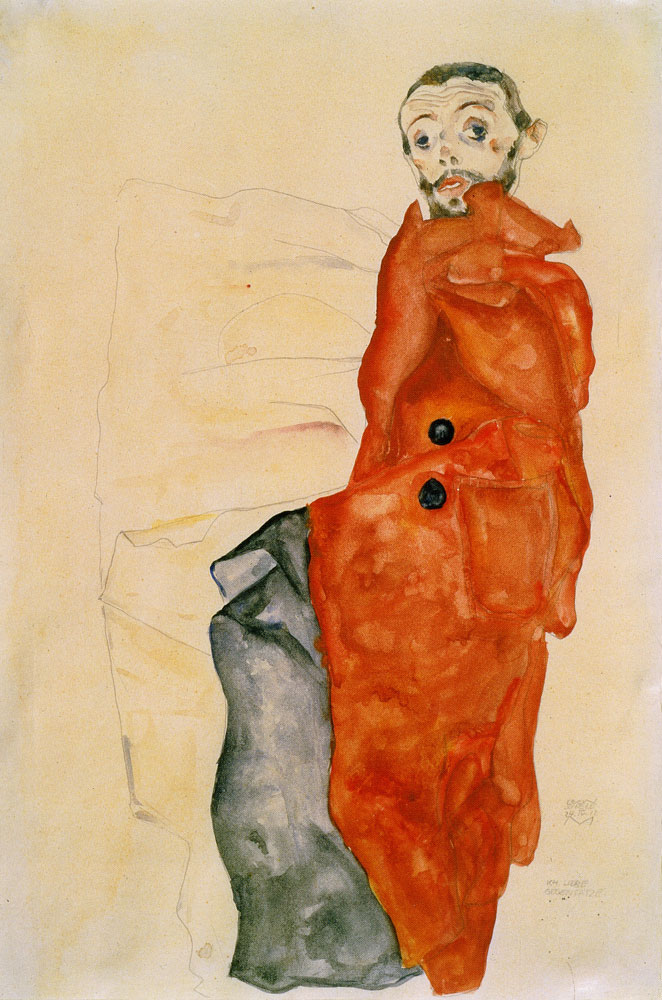
Showing posts with label art stolen from fritz grunbaum. Show all posts

Tuesday, November 13, 2018

London Lecture: From Murder To Museums: Abraham Lincoln, Adolf Hitler and the Hunt For Nazi Looted Art in America - November 19

In his presentation at the Fordham Centre London on this Monday November 19, From Murder To Museums: Abraham Lincoln, Adolf Hitler and the Hunt For Nazi Looted Art in America, Raymond J. Dowd, Partner - Dunnington Bartholow & Miller LLP - NYC  recounts how he seized two stolen Schieles after were spotting them at the Salon+Art Show at the Park Avenue Armory in November 2015, leading to international headlines upon restitution. The Schieles are now at Christie's auction house in New York pending an appeal.
 
Dowd traces how history's greatest murder has, until now, concealed history's greatest robbery.  The presentation traces Abraham Lincoln's idea of taking the profit out of war through the Lieber Code Executive Order 100 of April 1863, to the 1899 and 1907 Hague Conventions, to the Nuremberg Trials, to show that returning the stolen property to Holocaust victims was a truly American idea that was embraced by the Allied powers in the London Declaration of January 9, 1943.
 
Dowd discusses how 1. confiscatory US tax laws, 2. a fair market value deduction for artworks donated to museums, and 3. an unwillingness of museums to look gift horses in the mouth led to the current situation of US museums having to deal with large inventories of unprovenanced artworks that left Europe after 1933, but were created prior to 1946.   Learn how U.S. taxpayers foot the bill while America's elite filled the nation's greatest cultural institutions with toxic assets.

Dowd presents a new vision of how our museums can better fulfill their charitable and educational missions while respecting the often bloodstained history of the artworks in their care.

RSVP details at the link below:


www.dunnington.com
 Copyright law, fine art and navigating the courts. Attorney and AuthorCopyright Litigation Handbook (Thomson Reuters Westlaw 2017-2018) by Raymond J. Dowd
 Copyright Litigation Handbook on Westlaw

Saturday, August 05, 2017

From Murder To Museums: The Pursuit of Nazi Looted Art - August 16 Southampton NY


Please join me in Southampton New York on August 16 at the Rogers Memorial Library at noon for a presentation on Nazi looted art, the legacy that it has left our nation's museums and cultural institutions, and the controversies over restitution that are now engaging our nation's courts.  Learn how Abraham Lincoln's contribution to international law is now being used to pursue artworks stolen by Adolph Hitler and the Nazi Regime.  To register online visit http://alpha2.suffolk.lib.ny.us/iii/calendar/month/C&P=%7C1&R=80 by phone (631) 283-0774 ext 523.


Raymond Dowd Nazi Art Looting Lecture August 16 Southampton NY by Ray Dowd on Scribd
www.dunnington.com
 Copyright law, fine art and navigating the courts. Attorney and AuthorCopyright Litigation Handbook (Thomson Reuters Westlaw 2015-2016) by Raymond J. Dowd
 Copyright Litigation Handbook on Westlaw

Sunday, August 28, 2016

ArtLaw: Profiting From The Holocaust? Legal & Ethical Controversies Over Nazi Art Looting - Wayne State University Sept 14


September 14, 2016 | 7:00 p.m. - 9:00 p.m.

Category: Special Event
Location: Holocaust Memorial Center Zekelman Family Campus
28123 Orchard Lake Road
Farmington Hills, MI 48334
Cost: Varies
Calendars: Law School
Audience: Current Graduate Students, Faculty
The Arts, Communication, Entertainment and Sports Section of the State Bar of Michigan will present this program, which also is sponsored by the Jewish Bar Association of Michigan, Copyright Society of the USA and WSU's Cohn-Haddow Center for Judaic Studies.
Keynote speaker attorney Raymond J. Dowd will discuss the story behind Nazi looted art, through forced and coerced transfers, and the ethical and legal expectations of its return to its lawful owners. Dowd is a partner in the law firm of Dunnington Bartholow & Miller LLP in New York City.
Moderater will be Howard Lupovitch, associate professor of history and director of the Cohn-Haddow Center for Judaic Studies.

Cost for students is $5 in advance and $7.50 at the door. Cost for the general public is $10 in advance and $12.50 at the door. The event is free for Holocaust Center members.
Tickets: www.tinyurl.com/JBAM0914
 

 www.dunnington.com
 Copyright law, fine art and navigating the courts. Attorney and AuthorCopyright Litigation Handbook (Thomson Reuters Westlaw 2015-2016) by Raymond J. Dowd
 Copyright Litigation Handbook on Westlaw

Wednesday, November 18, 2015

Austria's Holocaust Denial: Judge Korman and DA Morgenthau Were Right: Dead City III and 80 Other Artworks By Egon Schiele Were Stolen From Fritz Grunbaum


Egon Schiele's Dead City III - Stolen from Fritz Grunbaum

In 1998, District Attorney Robert Morgenthau seized Egon Schiele's Dead City III from the Museum of Modern Art in New York City.   Here's what Judge Edward Korman said about Fritz Grunbaum and the evidence that the Nazis looted his art collection in a concurring opinion he wrote while sitting by designation on the US Court of Appeals for the Second Circuit in Bakalar v. Vavra, 619 F.3d 136 (September 2, 2010)(the bolding is mine):

EDWARD R. KORMAN, District Judge, separately concurring:
Often, when a verdict after a trial is reversed, other issues will be addressed which, though they do not affect the result, are likely to arise again on remand. While such a discussion may constitute dicta, it is justified by the desire to avoid the burden and expense that would result from the repetition of uncorrected error. Whether to undertake such an exercise is, of course, discretionary. While my colleagues, for perhaps understandable reasons, decline to engage in it, I take a different view and write to address more fully Part III of the panel opinion, which takes issue with the district judge's finding that the Grunbaum heirs had failed to produce “any concrete evidence that the Nazis looted the Drawing or that it was otherwise taken from Grunbaum.” Bakalar v. Vavra, 2008 WL 4067335, at *8.
While the panel opinion observes that “[o]ur reading of the record suggests that there may be such evidence,” [Panel Opinion, ante at *9] it does not say what that evidence is, nor does it discuss the legal principles applicable to what is essentially a mixed question of law and fact. The district judge is left to comb the record without assistance, looking for evidence he did not see the first time around, and without guidance as to the legal principles that make the evidence particularly relevant. I write to fill this gap.
Grunbaum was arrested while attempting to flee from the Nazis. After his arrest, he never again had physical possession of any of his artwork, including the Drawing. The power of attorney, which he was forced to execute while in the Dachau concentration camp, divested him of his legal control over the Drawing. Such an involuntary divestiture of possession and legal control rendered any subsequent transfer void.
“Under American law and the law of many foreign states there is only one scenario in which a good-faith purchaser's claim of title is immediately recognized over that of the original owner. This scenario arises when the owner voluntarily parts with possession by the creation of a bailment, the bailee converts the chattel, and the nature of the bailment allows a reasonable buyer to conclude that the bailee is empowered to pass the owner's title.” Patricia Youngblood Reyhan, A Chaotic Palette: Conflict of Laws in Litigation Between Original Owners and Good-Faith Purchasers of Stolen Art, 50 Duke L.J. 955, 971 (2001) (emphasis added). The principle to which Professor Reyhan alludes is codified in more limited form in section 2-403(2) of the Uniform Commercial Code, which was adopted by New York, and which provides that “[a]ny entrusting of possession of goods to a merchant who deals in goods of that kind gives him power to transfer all rights of the entruster to a buyer in ordinary course of business.” No such voluntary entrustment took place here. Nor did Grunbaum's flight from the Nazis constitute a voluntary abandonment.
Section 2-403(1) of the Uniform Commercial Code, which addresses principally the consequences of the transfer of title, rather than mere possession, provides that a person with voidable title has the power to transfer good title to a good-faith purchaser for value, and provides four examples of circumstances in which this rule applies. “The key to the voidable title concept appears to be that the original transferor voluntarily relinquished possession of the goods and intended to pass title.” Franklin Feldman & Stephen E. Weil, Art Law § 11.1.3 (1986). The Feldman *149 & Weil treatise continues: “He may have been defrauded, or the check he received may have bounced, or he may have intended to sell it to Mr. X rather than to Mr. Y, but, nevertheless, he intended to pass title. In such cases, the transferor has an option to void the sale, but the transferee can pass good title. A person who acquired the goods from a thief, however, has no title and consequently neither he nor successive transferees can pass ownership.” Id.; see also Thomas M. Quinn, Quinn's Uniform Commercial Code Commentary and Law Digest § 2-403[A][6] (2d ed., 2002). Grunbaum never voluntarily intended to pass title to the Drawing. On the contrary, the circumstances strongly suggest that he executed the power of attorney with a gun to his head.
Nevertheless, the district judge, relying on U.C.C. § 2-403(1), concluded that “Galerie St. Etienne was a seller with voidable title to the Drawing, having acquired it from Galerie Gutekunst in 1956,” and that Bakalar, a good faith purchaser for value, acquired good title to the Drawing. 2008 WL 4067335, at *6. While the district judge did not identify the defect in the title acquired by Galerie Gutekunst, which rendered voidable the title it passed to Galerie St. Etienne, his conclusion that the title was voidable implicitly recognizes that there was some legal defect in the passage of title to the Drawing as it made its way from Grunbaum to the Galerie Gutekunst. Otherwise, the district judge would have had no basis to characterize as “voidable” the title the latter conveyed to the Galerie St. Etienne. This characterization, however, ignores the fact that, if the power of attorney signed by Grunbaum was involuntary, any subsequent transfer was void and not merely voidable.
This case is analogous to the circumstances in two reported cases. In Vineberg v. Bissonnette, 548 F.3d 50 (1st Cir.2008), aff'g 529 F.Supp.2d 300, 307 (D.R.I.2007), the Nazis issued an edict directing the Jewish owner of an art gallery to liquidate the gallery and its inventory after determining that he “lacked the requisite personal qualities to be an exponent of German culture.” Id. at 53. After unsuccessfully appealing this edict, the owner “surrendered to the inevitable,” and consigned most of the affected works to a government-approved purveyor. Id. The consigned pieces, including a painting by Franz Xaver Winterhalter known as “Mädchen aus den Sabiner Bergen” (“Girl from the Sabine Mountains”), were auctioned at prices below their fair market value. Fearing for his life, the owner fled Germany shortly after the forced sale. Consequently, he never retrieved the auction proceeds. Id. The district court had little trouble in concluding that the owner's “relinquishment of his property was anything but voluntary,” 529 F.Supp.2d at 307, and that holding was not challenged on appeal.
Similarly, in Menzel v. List, the Jewish owners of a painting by Marc Chagall entitled “Le Paysan a L'echelle” (“The Peasant and the Ladder”) left their apartment in Brussels when they fled in March, 1941, before the oncoming Nazis. 49 Misc.2d 300, 301-2, 267 N.Y.S.2d 804 (1966), modified as to damages, 28 A.D.2d 516, 279 N.Y.S.2d 608 (1st Dep't 1967), rev'd as to modification, 24 N.Y.2d 91, 298 N.Y.S.2d 979, 246 N.E.2d 742 (1969). The painting was seized by the Nazis, who left a certification or receipt “indicating that the painting, among other works of art, had been taken into ‘safekeeping.’ ” Id. at 301, 267 N.Y.S.2d 804. The New York State Supreme Court Justice hearing the case concluded that the painting had not been abandoned because it did not constitute “a voluntary relinquishment of a known right.” Id. at 305, 267 N.Y.S.2d 804. The *150 Justice continued: “The relinquishment here by the Menzels in order to flee for their lives was no more voluntary than the relinquishment of property during a holdup.” Id. Consequently, he ordered the current possessor of the painting, and good-faith purchaser, to either return it to Mrs. Menzel or pay her $22,500, its fair value at the time of the case. Moreover, he also held that the good-faith purchaser could recover the $22,500 for breach of warranty of title from the Perls Galleries, from whom the painting was purchased. In so doing, the Justice explained:
It is of no moment that Perls Galleries may have been a bona fide purchaser of the painting, in good faith and for value and without knowledge of the saga of the Menzels. No less is expected of an art gallery of distinction. Throughout the course of human history, the perpetration of evil has inevitably resulted in the suffering of the innocent, and those who act in good faith. And the principle has been basic in the law that a thief conveys no title as against the true owner.
Id. at 314-15, 267 N.Y.S.2d 804 (citations omitted).5
Based on the historical record of the time, to which reference has already been made, the power of attorney Grunbaum signed in the fourth month of his confinement in Dachau does not appear to be any more voluntary a relinquishment of his legal interest in the Drawing than the acts discussed in Vineberg and Menzel. Bakalar's suggestion that the power of attorney constituted a voluntary entrustment of property to his wife is a proposition that remains for him to prove. Unless he does so, even if Mrs. Grunbaum “subsequently transferred the Drawing to her sister, Mathilde Lukacs, in 1938, to prevent it from falling into the hands of the Nazis,” as Bakalar alleges, she could not convey valid title to the artwork. Significantly, the district judge made no finding that any entrustment for this purpose even took place.
On this score, Bakalar's amended complaint, which was filed on the eve of trial, posits two theories for what happened to the collection: 1) “that Elisabeth succeeded in hiding the [Drawing] from the Nazis prior to her deportation, and that her sister, Lukacs-Herzl, managed to take the collection with her into exile in Belgium,” or 2) “that after the Grunbaum's apartment was aryanized by the Nazis in 1938, the family's library and art collection were purchased by a Viennese antiquarian bookseller who lived in the same neighborhood for approximately $90, and that the Viennese bookseller then either sold or gave the collection to Lukacs-Herzl at some point thereafter.” (A-277.) Of course, the second alternative assumes that the property was taken by the Nazis, and Bakalar acknowledges that, even under the first theory, scholars believe it is unlikely that Lukacs-Herzl could have saved the entire collection given the circumstances under which she left Austria. Indeed, Grunbaum's heirs offered expert evidence consistent *151 with the premise that Lukacs-Herzl could not have removed or salvaged the paintings because “she was a Jewish woman who was interned in a Belgian work camp by the Nazis until 1944 after she fled Vienna together with her husband. It is more likely that a person like Kieslinger with direct ties to the Nazis took possession of the Grunbaum collection.” (A-1273.) Significantly, neither of the two theories posited by Bakalar are predicated on the assumption that Mrs. Grunbaum voluntarily gave over Fritz Grunbaum's art collection to either Lukacs-Herzl or the Nazis who aryanized her apartment.
Nor do the district court's findings of fact support Bakalar's argument “that someone in the Grunbaum family more likely than not exported the Drawing from Vienna.” The district judge merely speculated that “[t]he Drawing could have been one of the 417 drawings Elisabeth Grunbaum possibly exported ... in 1938,” or that the Drawing “could have been one of three drawings Lukacs's husband exported,” or that “it could have been” one of the three watercolors exported by Lukacs's brother-in-law. 2008 WL 4067335, at *8 (emphasis added). These scenarios, based on pure speculation, do not constitute findings by a preponderance of the evidence that what “could have” happened, actually did happen.
Moreover, although Bakalar now claims that there is no “direct evidence that all of the Schiele art sold by Lukacs had once belonged to Fritz Grunbaum,” or that “the Drawing belonged to Fritz Grunbaum prior to or during the war,” there is significant circumstantial evidence that this artwork had belonged to him. Indeed, the district judge decided the case on this premise, and it was supported by the deposition testimony of Eberhard Kornfeld, a partner at Galerie Gutekunst, and the trial testimony of Jane Kallir, the current director of the Galerie St. Etienne. Significantly, the Sotheby's Catalogue Description for the Drawing, February 8, 2005, which it prepared on Bakalar's behalf, listed the provenance as follows:
Fritz Grunbaum, Vienna (until 1941)
Elisabeth Grunbaum-Herzl, Vienna (widow of the above; until 1942; thence by decent)
Mathilde Lukcas-Herzl (sister of the above)
Gutekunst & Klipstein, Bern (on consignment from the above by 1956)
Galerie St. Etienne, New York
Norman Granz, New York
Galerie St. Etienne, New York
Acquired from the above by the present owner
(A-700.)
The admission by Sotheby's as to the initial provenance of the Drawing was confirmed by the judicial admission regarding its provenance in Bakalar's original complaint. See Official Comm. of the Unsecured Creditors of Color Tile, Inc. v. Coopers & Lybrand, LLP, 322 F.3d 147, 167 (2d Cir.2003). Specifically, Bakalar alleged in his complaint that:
The Drawing has an established and documented provenance. It originally belonged to the collection Fritz Grunbaum, a well-known Vienesse cabaret performer. In 1938, the Nazis confiscated Grunbaum's residence and inventoried the contents of his art collection. Grunbaum was deported to Dachau, where he died in 1941. His wife, Elisabeth, died the following year. By all credible accounts, however, the Grunbaum art collection escaped confiscation by the Nazis, and the collection, including the Drawing, subsequently came in to the possession of Grunbaum's sister-in-law, Mathilde Lukacs-Herzl, after the war.
*152 (A-217.) On the eve of trial, Bakalar moved to file an amended complaint, deleting his admission as to the initial provenance of the Drawing, because it was based on information he obtained from Kornfeld, who had come to this conclusion in 1998 after he learned of Fritz Grunbaum's relationship to Lukacs-Herzl. While Bakalar was apparently permitted to file an amended complaint, Kornfeld and Kallir had sufficient expertise in the field to provide competent evidence on this score. Nor is it any answer to argue, as Bakalar does here, that their opinion was based on circumstantial rather than direct evidence. Moreover, notwithstanding the amended complaint, Bakalar's admission as to the provenance of the Drawing constitutes competent evidence that the trier of fact is free to consider, along with Bakalar's explanation for its inclusion in the original complaint.
In sum, my reading of the record suggests that there is substantial evidence to support the claim of the Grunbaum heirs that the Drawing was owned by Grunbaum and he was divested of possession and title against his will.

***

As set forth above, both Swiss art dealer Eberhard Kornfeld and art dealer Jane Kallir swore that each of the Egon Schieles sold in a 1956 sale in Berne, Switzerland at the Gutekunst & Klipstein gallery (now Galerie Kornfeld), belonged to Fritz Grunbaum when he was deported to Dachau and murdered.   Right now Austria is engaging in Holocaust denial by refusing to restitute these stolen artworks to the heirs of Fritz Grunbaum.  The story of a Grunbaum family member selling the works in Switzerland is a complete fabrication.  But even if true, as Judge Korman correctly points out, artworks stolen stolen from a concentration camp victim remain stolen even if a family member later stole it back from Nazis (this is the actual nutty Austrian theory).

The actual Nazi records show that they robbed everything from the Grunbaums.  The Jewish Property Declarations have stamps that say "Gesperrt" and "Erledigt" which indicate that the art collection and other property had been liquidated for the Reich by 1939.

How can Austria continue to deny the Holocaust in the face of such clear evidence?

For more information on the life and art collection of Fritz Grunbaum, please visit https://artstolenfromfritzgrunbaum.wordpress.com/

www.dunnington.com
 Copyright law, fine art and navigating the courts. All practice, no theory.Copyright Litigation Handbook (Thomson Reuters Westlaw 2014-2015) by Raymond J. Dowd
 Copyright Litigation Handbook on Westlaw

Monday, March 09, 2015

Nazi Looted Art: Cases, Ethics and Law - March 24, 2015 Westchester Women's Bar Association


Nazi Looted Art: Cases, Ethics and Law


Presenter: Raymond Dowd, Esq.  
With last year’s film Monuments Men, the upcoming Woman in Gold starring Helen Mirren and Ryan Reynolds, and with the documentary The Rape of Europa on PBS, the story of Adolph Hitler’s art looting program is finally gaining Hollywood’s attention. A find of 1,400 artworks in Munich last year in the possession of Cornelius Gurlitt, the son of one of Hitler’s art dealers, raised an international firestorm. But the unfinished business of World War II remains unfinished, with governments and families continuing to trace stolen artworks that are hidden in public and private art collections worldwide. With D.A. Robert Morgenthau’s seizure of Egon Schiele’s Portrait of Wally and Dead City III in 1998, world attention focused on the topic. Speaker Raymond J. Dowd of Dunnington Bartholow & Miller LLP brought the first federal Holocaust-era Nazi art looting case to trial in the Southern District of New York and argued it twice to the Second Circuit. In an entertaining and art-filled lecture, he will present the law, the history and the ethical concerns that continue to face our courts today.

Date: Tuesday, March 24, 2015
Time: 6:00 p.m. - 6:30 p.m. Registration and Networking
6:30 p.m. - 8:00 p.m. Program
Place: Toscana Ristorante
214 Main Street, Eastchester, NY 10707
Fee: $55.00 for WWBA members, $65.00 for non-members.

Dinner; cash bar

RSVP: By March 19h, 2015 to
Executivedirector@wwbany.org
1.5 CLE Credits (includes 0.5 hr. Ethics)1
Attendance limited to WWBA and WPBA members and their invited guests.
www.dunnington.com
 Copyright law, fine art and navigating the courts. All practice, no theory.Copyright Litigation Handbook (Thomson Reuters Westlaw 2014-2015) by Raymond J. Dowd
 Copyright Litigation Handbook on Westlaw

Friday, October 17, 2014

NAZI ART LOOTING RESTITUTION SETTLEMENT AGREEMENT LEADS TO CHRISTIE’S AUCTION OF RARE ARTWORK

New York, NY (MMD Newswire) October 16, 2014 - Christie's auction house today announced the upcoming November 5 evening Impressionist and Modern auction of Town on the Blue River (1910) an extremely rare watercolor landscape by the Austrian artist Egon Schiele (1890-1918). The auction is the result of the successful resolution of a restitution settlement agreement with the estate of Fritz Grünbaum, a Viennese Jewish cabaret performer in (1880-1941) who died in the Dachau Concentration Camp.


Town on the Blue River (Stadt am blauen Fluss - Krumau)(1910)
In 1998, the plight of Fritz Grunbaum and his death in Dachau gained international headlines when District Attorney Robert Morgenthau seized Dead City III from the Museum of Modern Art in New York City. Dead City III, together with 80 other artworks by Egon Schiele were in Grünbaum's apartment in Vienna when the Gestapo arrested him on March 22, 1938 and deported him to Dachau, where he was murdered. Although the MoMA was compelled to return Dead City III to Austria because its exhibition at MoMA in New York was immunized from seizure by treaty, the seizure garnered international headlines and led to the Washington Conference on Holocaust-Era Assets in 1998 and to an international movement in favor of returning Nazi-looted artwork to Holocaust victims and their survivors.

Recent films such as George Clooney's Monuments Men and The Rape of Europa based on Allied efforts during World War II to recover artworks stolen by the Nazi regime have rekindled interest in recovering artworks belong to Jewish families.

Attorney Raymond J. Dowd of Dunnington, Bartholow & Miller LLP www.dunnington.com in New York City stated: "On behalf of the Grunbaum heirs, I thank the Estate of Ilona Gerstel and Christie's for their cooperation in resolving the Holocaust restitution claim to Stadt am Blauen Fluss (Krumau) by Egon Schiele. The Grunbaum heirs and I are very pleased to completely support the sale of this important work at the Impressionist and Modem Evening Sale on November 5, 2014 in New York. We also want to acknowledge and thank the late Ilona Gerstel for her generosity in designating several important Holocaust-related charities as beneficiaries of her Estate."

www.dunnington.com
 Copyright law, fine art and navigating the courts. All practice, no theory.
Copyright Litigation Handbook (Thomson Reuters Westlaw 2012-2013) by Raymond J. Dowd Copyright Litigation Handbook on Westlaw